You probably haven't been able to turn on your computer and surf the Internet the last few days without running into a story about Barrie, Ontario area parents claiming their children are being made sick by Wi-Fi radiation in the schools. The media is giving all kinds of attention to one or two scientists who are saying there might be a health concern. Unfortunately, it is giving little more than lip service to the vast bulk of the scientific community who say the opposite.
Sure, many publications have expressed some more or less skeptical opinions - in a wishy-washy kind of way, but no one, anywhere, is telling it straight. No one is saying what should be said. No one is saying that there isn't a shred of credible evidence that there is any harm whatsoever from Wi-Fi signals. No one is saying that the cell phones all these kids have glued to their heads twenty-four hours a day emit considerably more radiation - in the same frequency range - than Wi-Fi transmitters. Heck your DVD player emits more RF radiation than your wireless router, but I don't see any of these parents cutting up their Blockbuster cards.
What needs to be said - loud and clear - is that, in order for the claims of this group to be in any way valid; in order for there to be a health risk from Wi-Fi signals, everything we currently understand about physics would have to be wrong. I'm not talking about a minor correction to our scientific understanding of the world. I mean we'd have to throw the laws of nature out the window and start all over again. Microwave radiation is non-ionizing. That means it doesn't have enough power to damage cells beyond heating them. A typical microwave oven is about 1000 watts. A typical cellphone is less than one watt. What that means is, in order to reheat your cold cup of Tim's to a piping hot, drinkable state (what your microwave would do in about one minute), you'd have to hold your cell phone up to the cup for around seventeen hours...in a shielded box that didn't allow any of the radiation to escape into the environment at large...in an insulated cup that didn't allow any of the heat to escape into the air. OK, let's be honest, it's impossible. And your average Wi-Fi transmitter is about half the power of a cell phone - and typically not held up against your head.
This idea - that Wi-Fi radiation can somehow be harmful to people's health - is what we, in the skeptical community refer to as, "not even wrong." What we mean by that is it is an idea that is so far out of the realm of reason that it's like asking how many pot-roasts the Yankees scored last night. It's a statement that doesn't even make sense in the context of a reasonable discussion. No, these parents are barking up the wrong area rug. They're "not even wrong."
August 19, 2010
The (not so) great wi-fi debate

August 08, 2010
(not quite) 100 more SF books everybody should read!
Kelly has come across another list of somebody's opinion of indispensible science fiction novels. He called it 100 more SF books..., but I only count 84. This list overlaps the previous one only a small amount. Once again, I will boldinicize those titles I have read, and add commentary where the inclination strikes me.
1. The Forever War – Joe Haldeman
2. I Am Legend – Richard Matheson
3. Cities in Flight – James Blish I have this book (got it for Christmas a couple of years ago from an online secret santa gift exchange). I haven't read it yet.
4. Do Androids Dream of Electric Sheep? – Philip K. Dick
5. The Stars My Destination – Alfred Bester
6. Babel-17 – Samuel R. Delany
7. Lord of Light – Roger Zelazny
8. The Fifth Head of Cerberus – Gene Wolfe
9. Gateway – Frederik Pohl
10. The Rediscovery of Man – Cordwainer Smith
11. Last and First Men – Olaf Stapledon
12. Earth Abides – George R. Stewart
13. Martian Time-Slip – Philip K. Dick
14. The Demolished Man – Alfred Bester
15. Stand on Zanzibar – John Brunner
16. The Dispossessed – Ursula K. Le Guin
17. The Drowned World – J. G. Ballard
18. The Sirens of Titan – Kurt Vonnegut
19. Emphyrio – Jack Vance
20. A Scanner Darkly – Philip K. Dick
21. Star Maker – Olaf Stapledon
22. Behold the Man – Michael Moorcock
23. The Book of Skulls – Robert Silverberg
24. The War of the Worlds – H. G. Wells
25. Flowers for Algernon – Daniel Keyes I have not read the novel, but I have read the short story by the same author upon which the novel was based.
26. Ubik – Philip K. Dick
27. Timescape – Gregory Benford
28. More Than Human – Theodore Sturgeon
29. Man Plus – Frederik Pohl
30. A Case of Conscience – James Blish
31. The Centauri Device – M. John Harrison
32. Dr. Bloodmoney – Philip K. Dick
33. Non-Stop – Brian Aldiss
34. The Fountains of Paradise – Arthur C. Clarke
35. Pavane – Keith Roberts
36. Now Wait for Last Year – Philip K. Dick
37. Nova – Samuel R. Delany
38. The First Men in the Moon – H. G. Wells
39. The City and the Stars – Arthur C. Clarke
40. Blood Music – Greg Bear
41. Jem – Frederik Pohl
42. Bring the Jubilee – Ward Moore
43. VALIS – Philip K. Dick
44. The Lathe of Heaven – Ursula K. Le Guin
45. The Complete Roderick – John Sladek
46. Flow My Tears, the Policeman Said – Philip K. Dick
47. The Invisible Man – H. G. Wells
48. Grass – Sheri S. Tepper
49. A Fall of Moondust – Arthur C. Clarke
50. Eon – Greg Bear
51. The Shrinking Man – Richard Matheson
52. The Three Stigmata of Palmer Eldritch – Philip K. Dick
53. The Dancers at the End of Time – Michael Moorcock
54. The Space Merchants – Frederik Pohl and Cyril M. Kornbluth
55. Time Out of Joint – Philip K. Dick
56. Downward to the Earth – Robert Silverberg
57. The Simulacra – Philip K. Dick
58. The Penultimate Truth – Philip K. Dick
59. Dying Inside – Robert Silverberg
60. Ringworld – Larry Niven
61. The Child Garden – Geoff Ryman
62. Mission of Gravity – Hal Clement
63. A Maze of Death – Philip K. Dick
64. Tau Zero – Poul Anderson
65. Rendezvous with Rama – Arthur C. Clarke
66. Life During Wartime – Lucius Shepard
67. Where Late the Sweet Birds Sang – Kate Wilhelm
68. Roadside Picnic – Arkady and Boris Strugatsky
69. Dark Benediction – Walter M. Miller, Jr.
70. Mockingbird – Walter Tevis
71. Dune – Frank Herbert
72. The Moon Is a Harsh Mistress – Robert A. Heinlein
73. The Man in the High Castle – Philip K. Dick
74. Inverted World – Christopher Priest
75. Cat’s Cradle - Kurt Vonnegut
76. The Island of Dr. Moreau - H.G. Wells
77. Childhood’s End - Arthur C. Clarke
78. The Time Machine - H.G. Wells
79. Dhalgren - Samuel R. Delany
80. Helliconia - Brian Aldiss
81. Food of the Gods - H.G. Wells
82. The Body Snatchers - Jack Finney
83. The Female Man - Joanna Russ
84. Arslan - M.J. Engh
Like the previous list, this one seems Philipp K. Dick happy. In fact, there are more Dick books on this one than the last, and only a few of them are duplicates. How many books did this guy write? It seems that there are dozens of novels on this list by authors I have read other works by, but not the ones listed here. Also, there are a good number of books on this list that I've never even heard of before. I guess, between this list and the last, I won't have to look far for ideas when I need something new to read.
How did you fare on this list?
August 01, 2010
Hello, Police? I'd like to report a stolen show.
The second annual Aurora Jazz+ Festival was held this past Friday night and Saturday. I didn't have a chance to see any of the Friday night performers, but I spent the entire day at the Town Park Saturday listening to the Jazz, Blues, R&B, Pop, Folk, and Rock music line-up the organizers had put together. Along with returning artists like Joel Krivy, Bobby Rice and the Mike Massaro Band, there were a bevy of new performers along for the ride.
The organizers, George and Sher St.Kitts, seem to be dedicated to showcasing as much local talent as possible, and included many amateur, semi-pro, and up and coming York Region performers. The absolute highlight of the show, for me, was Stacey Kaniuk - a cute-as-a-button local girl with a voice that'll knock your socks off. This girl cannot be far from breaking through into the big time. During a hot enough to set the stage on fire rendition of the James Brown hit It's a Man's Man's Man's World, the performers due up next stood on the alternate stage, arms crossed, watching the rug being pulled out from under them. This is a singer-songwriter on her way to the top, mark my words.

Other local performers included the amateur acts Higher Ground and Six Way From Sunday, and aspiring pros Chris Hau, and The Julian Troiano Band. Also in the mix were the traditional Jazz sounds of the After Hours Big Band - another local group - and big name headliner Robert Michaels' cuban/flamenco (cubamenco) guitar stylings.

The event was in support of two local charities; The Canadian Center for Abuse Awareness, and Safehaven.
I was somewhat disappointed with the turnout this year. The park was pretty much empty until evening. Most of the spectators came out to see Robert Michaels play after 8:00PM, but during the day acts were, unfortunately, playing to a sparse littering of no more than a couple hundred people. I'm not sure whether the problem was the timing - on a summer long weekend - or a lack of widespread promotion, or something else - or, more likely, a combination of these factors, but hopefully next year's event will be better attended.
For more pictures of the event, visit my Flickr photoset.
July 27, 2010
The ABCs of Curling - Y
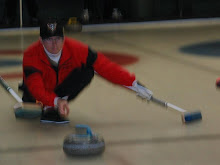
 is for Yellow, a common identifying colour for curling rocks. At one time, curlers owned their own rocks, and brought them to the rink for each game. Everybody's rocks were different, and one became familiar with the way one's rocks behaved on the ice. Different stones would go farther, or stop sooner. They might curl more, or less than other people's rocks. As the game evolved, and rules became more universally standardized, and clubs accquired their own buildings and facilities, privately owned rocks fell by the wayside. A friend of mine recently mentioned to me that he has one of his grandfather's old curling stones propping open a door in his house in St. Catherines.
The goal of any modern curling club is to have all of thier rocks behave the same way on the ice. In reality, that turns out to be something of an impossible dream. There are just too many variables involved, and miniscule variations in the texture of the running surface can result in dramatic differences in how far a rock will travel, or curl. Most icemakers will spend a not insignificant amount of time throwing all the rocks in the club, and trying to pair up - or 'match' - identically running rocks to make sets of eight that will be at least similar to each other during game play. This is an exhaustingly laborious undertaking, and as such, most clubs rocks will be matched in only the most rudimentary manner. And that doesn't even take into account the fact that a rock's behaviour might change over time as it's running surface wears.
At large national and international curling events being contested by the best teams in the world, exceptional care is taken to ensure the curlers are playing with the best possible rocks. The Canadian Curling Association keeps a set of top quality stones that they transport around the country for use at major CCA sanctioned events. Before, say, the Brier national championship, the stones will be carefully matched so the players can have the best possible experience on the ice. With all this care, the players still find minor differences between the rocks, and will often swap rocks around in throwing order based on how they believe they will behave under different circumstances. During the course of the week at one of these events, as teams play on each different sheet of ice, using each different set of rocks, they will meticulously chart the performance of the stones. Should they reach the finals, they will be allowed to select any of the rocks from across the rink to assemble a set of eight they like.
At most organised bonspiels, rock colour is preselected for the teams before they go on the ice. During regular in-club league play, however, the team who is throwing first as determined by the coin toss will usually select whether to throw blue or yellow rocks. Regular club curlers will often have their own opinions which colour rocks are better to choose on any given sheet based upon prior experience. Of course, during the off season, the rocks might be stored without handles, and reassembled in a different order the next year. Or, the running surfaces might be retextured at some point, which changes everything. Each team starts a new year in club curling having to suss out the rocks all over again before they come to a conclusion, like: "on ice two, don't take blue!"
<- Start at the beginning.
July 23, 2010
100 SF books everyone should read...
Kelly points out a list, at Bookstove.com, of 100 Science Fiction Novels Everyone Should Read. They don't give any commentary on these books at all. They just say, "hey, you should read these." As with all such lists, it is highly subjective. There are books on this one I'd probably leave off, and books I've read that I think should be here. What are your thoughts?
Taking a cue from Kelly, I've emboldenated the ones I've read, and added commentary here and there.
1. The Postman – David Brin
2. The Uplift War – David Brin Of course, this is the third book of a trilogy, so if you want to pick up some Brin, I wouldn't start with this one.
3. Neuromancer – William Gibson Big fan of Gibson. Highly recommended.
4. Foundation – Isaac Asimov
5. Foundation and Empire – Isaac Asimov
6. Second Foundation – Isaac Asimov ...and the multitudinous sequels and prequels - I have seven Foundation Series novels.
7. I, Robot – Isaac Asimov
8. The Long Tomorrow – Leigh Brackett
9. Rogue Moon – Algis Budrys
10. The Martian Chronicles – Ray Bradbury
11. Fahrenheit 451 – Ray Bradbury I'm pretty sure I've read this one, but I don't really remember it at all.
12. Something Wicked This Way Comes – Ray Bradbury
13. Childhood’s End – Arthur C. Clarke My grade ten english teacher passed copies of this book out to the class, and told us to read it for an upcoming assignment. He never mentioned it again.
14. The City and the Stars – Arthur C. Clarke
15. 2001: A Space Odyssey – Arthur C. Clarke
16. Armor – John Steakley
17. Imperial Stars – E. E. Smith On this list? Perhaps as an example of Golden Age Science Fiction pulp novels, but important? Good? No, I wouldn't say so.
18. Frankenstein – Mary Shelley I've tried to read this several times, but have bounced off (as Kelly puts it) the antiquated writing style.
19. Ender’s Game – Orson Scott Card
20. Speaker for the Dead – Orson Scott Card
21. Dune – Frank Herbert
22. The Dosadi Experiment – Frank Herbert I'm a fan of Herbert, but I think Dune is probably representative enough for this list. Not sure why such an obscure example of his work appears here.
23. Journey Beyond Tomorrow – Robert Sheckley
24. The Hitchhiker’s Guide to the Galaxy – Douglas Adams
25. Do Androids Dream of Electric Sheep? – Philip K. Dick
26. Valis – Philip K. Dick
27. A Scanner Darkly – Philip K. Dick
28. The Three Stigmata of Palmer Eldritch – Philip K. Dick Hard to believe I've never read any P.K. Dick. I should do something about that. Having said that, is his work really important enough to rate five inclusions on this list?
29. 1984 – George Orwell
30. Slaughterhouse Five – Kurt Vonnegut
31. Cat’s Cradle – Kurt Vonnegut
32. The War of the Worlds – H. G. Wells
33. The Time Machine – H. G. Wells
34. The Island of Doctor Moreau – H. G. Wells
35. The Invisible Man – H. G. Wells
36. A Canticle for Leibowitz – Walter M. Miller, Jr.
37. Alas, Babylon – Pat Frank
38. A Clockwork Orange – Anthony Burgess
39. A Journey to the Center of the Earth – Jules Verne
40. From the Earth to the Moon – Jules Verne
41. Twenty Thousand Leagues Under the Sea – Jules Verne
42. Old Man’s War – John Scalzi Again, not sure why this one's here. I mean, it was a pretty good book, but I wouldn't call it excellent, literary, or important.
43. Nova Express – William S. Burroughs
44. Ringworld – Larry Niven I've read just about everything Niven's written. Yep, a fan.
45. The Mote in God’s Eye – Larry Niven and Jerry Pournell
46. The Unreasoning Mask – Philip Jose Farmer
47. To Your Scattered Bodies Go – Philip Jose Farmer
48. Eon – Greg Bear
49. Jurassic Park – Michael Crichton
50. The Andromeda Strain – Michael Crichton
51. Lightning – Dean Koontz
52. The Stainless Steel Rat – Harry Harrison
53. The Fifth Head of Cerebus – Gene Wolfe
54. Nightside of the Long Sun – Gene Wolfe
55. A Princess of Mars – Edgar Rice Burroughs
56. Cryptonomicon – Neal Stephenson
57. Snow Crash – Neal Stephenson Another author I really have to read.
58. The Stars My Destination – Alfred Bester
59. Solaris – Stanislaw Lem
60. Doomsday Book – Connie Wills And another.
61. Beserker – Fred Saberhagen
62. Time Traveler’s Wife – Audrey Niffenegger
63. The Word for World is Forest – Ursula K. LeGuin
64. The Dispossessed – Ursula K. LeGuin
65. Babel-17 – Samuel R. Delany
66. Dhalgren – Samuel R. Delany
67. Flowers for Algernon – Daniel Keyes
68. The Forever War – Joe Haldeman
69. Star King – Jack Vance
70. The Killing Machine – Jack Vance
71. Trullion: Alastor 2262 – Jack Vance
72. Hyperion – Dan Simmons
73. Starship Troopers – Robert A. Heinlein
74. Stranger in a Strange Land – Robert A. Heinlein
75. The Moon is a Harsh Mistress – Robert A. Heinlein
76. A Wrinkle in Time – Madeleine L’Engle
77. More Than Human – Theodore Sturgeon
78. A Time of Changes – Robert Silverberg
79. Gateway – Frederick Pohl
80. Man Plus - Frederick Pohl
81. The Day of the Triffids – John Wyndham Lots of people seem to have studied this book in high school. I didn't.
82. Mission of Gravity – Hal Clement
83. The Execution Channel – Ken Macleod
84. Last and First Men – W. Olaf Stapledon
85. Slan – A. E. van Vogt
86. Out of the Silent Planet – C. S. Lewis Here's a classic I should check out.
87. They Shall Have Stars – James Blish
88. Marooned in Realtime – Vernor Vinge
89. A Fire Upon the Deep – Vernor Vinge
90. The People Maker – Damon Knight
91. The Giver – Lois Lowry
92. The Handmaid’s Tale – Margaret Atwood
93. Contact – Carl Sagan Saw the movie, but haven't read ths book.
94. Atlas Shrugged – Ayn Rand
95. The Fountainhead – Ayn Rand
96. Battlefield Earth – L. Ron Hubbard Yeah, I really did. Take my advice: don't.
97. A Connecticut Yankee in King Arthur’s Court – Mark Twain
98. Little Brother – Cory Doctorow I've read other Doctorow, but this one's pretty new.
99. Invasion of the Body Snatchers – Jack Finney
100. Planet of the Apes – Pierre Boulle There was a book?
Well, looks like I've read 40% of these titles. I was doing really well on the top half of the list, but fell off a bit on the bottom half. Author's I think probably should have made this list:
Cordwainer Smith
Roger Zelazny
What do you think?
July 20, 2010
Fionavar Tapestry Character Test
This has been sitting in my Test Journal since April 24, 2007. I never published it here before because I didn't think anyone would be interested. Activity here being what it is, however, I thought I'd dig out some old stuff just to let everyone know I'm not dead or something. 
I'm Paul Schafer!
Take The Fionavar Tapestry Character Test today!
Created with Rum and Monkey's Personality Test Generator.
So, WTF? The Fionavar Tapestry is a fantasy trilogy by Canadian author Guy Gavriel Kay of which I am very fond (the trilogy, I mean - OK, and the author, too). If you haven't read it, the quiz results will be somewhat meaningless to you. Also, if you haven't read it, I recommend you do so. It's rather good.
July 12, 2010
Monday Stealing
I ripped this off from Kelly, who, apparently, ripped it off from somewhere else (as it was meant to be ripped). I'm not a big quiz kinda guy, but this one fed right into my own personal sense of misanthropy and self-superiority. You probably shouldn't read it.
1. Lindsay Lohan was recently sentenced to 90 days in jail. What do you think her future has in store for her?
Who cares?
2. What is the biggest fashion "don't" that you would like to police?
Who cares?
3. How should we punish sites that lure us in with "read this" and take us somewhere where we are first greeted by a pop-up and then a series of click throughs to actually read the meat of the story?
Be smart enough to not click on the lure link in the first place. I mean, c'mon, they're pretty damn easy to spot, you know. Also, who cares?
4. What is the most you will do to post a comment on a site? At what point is it not worth posting a comment?
I usually balk at signing up for some proprietary commenting system that isn't widely used. I mean, I have a Blogger (Google) ID, an AOL ID, a Wordpress ID, a Yahoo! ID and a Typekey ID. If your blog uses some other sign-up required system that I've never even heard of before, I'm unlikely to make the effort, 'cause, you know, who cares? Unless, of course, I need to point out how stupid you are, or something.
5. If you purchase something online and you are charged for postage, is it still reasonable to charge for "shipping and handling"? What exactly does "shipping and handling" entail?
"Shipping and handling" is just another scam way of inflating the profit on your sale. I just add it to the purchase price in my head and then decide if I think it's still a good deal. Ebay users who charge it deserve to be shot. And, to carry on the theme, "who cares!"
That's all.
July 01, 2010
Oops.
In my recent inactivity and inattention, I have let my blogiversary pass unmarked. This past Monday was the sixth birthday of Aurora Walking Vacation. What, you're skeptical? Please allow me to present my evidence.
As you were.
May 20, 2010

April 26, 2010
The ABCs of Curling - X
 is for X-Rated. If the nineties was the decade curling discovered it had an audience, the 2000s will be remembered as the decade curling discovered it had sex appeal. Several internet lists of "Olympic Hotties" at the 2010 Vacouver games were topped by then 43-year-old Canadian skip Cheryl Bernard, and included many other curling athletes - women and men included. But this was not always the way.
In 1987, with the Calgary Olympic games around the corner and curling included as a demonstration sport, the Canadian Curling Association issued a directive to several national level curlers expected to compete at that year's Olympic trials: lose weight. Ed Werenich, a former Canadian and World champion, considered one of the favourites to represent Canada the following year, took great umbrage at the threat of being excluded from the trials if the national body did not consider him 'fit enough.' If a team is winning at an elite level, what matter if the members weigh two hundred, or even three hundred pounds, he argued. He and his vice, Paul Savage, threatened to show up to the trials with a case of beer as a training aid, and a local exotic dancer as their official coach. In the end, cooler heads prevailed, and Eddie showed up without "Marina" and eighteen pounds lighter - a fact on which he blames his loss to this day (the weight difference, not the lack of a stripper).
In the end, the CCA needn't have worried. The general rise in the level of competition in the upper echelons of the game over the past three decades has resulted in elite level curlers looking to improve their overall fitness levels in order to remain competitive on the world stage. Kevin Martin's 2010 Olympic gold medal winning squad became so devoted to their fitness regimens it led vice John Morris to write a book about curling specific exercise routines.
In 2006, following on the rousing success of naked or nearly naked fundraising calendars from firefighters, golfers, quilting guilds, skeptics (and skep-chicks), Andorran professional photographer and competitive curler Ana Arce convinced a dozen world-class curling women to pose nude or semi-nude for their own calendar, Fire on Ice. The project was successful enough to spawn a 2007 version. It lapsed in 2008, but was revived in '09 and published almost every year since, sometimes alternating years between male and female models, and some years featuring both.
Clearly, even in curling, sex sells.
[edited 09/23/2019 to add more up to date calendar information]
Start at the beginning.
April 12, 2010
Concerning Debcons, and The Great Tim Tam Heresy
My friends, my dear, dear friends, we have been led astray. The path we have been following faithfully, it turns out, is but a maze of deception. We have been led astray.
Let me explain.
It was the best of times, it was the worst of times. It was about seven o'clock on a Saturday night. Most of us had arrived at Lai Toh Heen restaurant near Mount Pleasant and Eglinton for our "Taste of Kitai" dinner and Debcon Bright Weavings Get Together. Things were going about as usual. Guy was buying drinks (thank you, Sir); people were renewing old accquaintances, and making new ones; we were all admiring Niel's authentic first off the press editions of Lord of Emperors, Ysabel, and Under Heaven; I was calling Paula on my cell phone... As is also usual at these gatherings, new people were fitting in like old friends. At one point, I wandered over to the other table to see how things were going. Loni was there. Our eyes met. There was a sudden hush around the table - almost a stillness in the room. And then, she said those three little words: "I brought Tim-tams."
For a moment, I didn't say anything. Then, as is my wont, I tried to make light of the situation. "Where," I said, "are we going to find hot chocolate?"
It was Loni's turn to spend a moment in silence. The look of confusion on her face alarmed me. "What," she finally managed, "what ever would you want with hot chocolate?"
I looked around furtively. There were several of the uninitiated in the room. I leaned in close. I whispered, "you know, for the...slams."
She laughed. Not with malice, but with affection. She patted my hand reassuringly, much as one would pat the hand of a young child who had just announced that he doubted the existence of Santa Claus, or the Easter Bunny... or Jesus. "Silly boy," she said. "You do Tim-tam slams with coffee, not hot chocolate."
The room spun. I struggled to maintain my footing on a floor threatening to fall out from under me. "But, but, Thunderchi-, Terry... he said-"
Someone else spoke then. In my condition I could not even tell who, but the words shall be burned indelibly on my soul from this time until eternity: "Paul, Terry didn't drink coffee." At last the heresy was revealed. Terry, Thunderchild, he who preceeded us all, had taught us an alternative Tim-tam slam. He had modified the traditional ritual in order to suit his own, personal tastes and preferences. Our slamming had never been authentic. From the very beginning, we had indulged in a fake cultural phenomenon. Happily, blissfully unaware of the error of our ways, we had slammed Arnott's Chocolate Biscuits using the wrong hot drink. We were like Anglicans taking fake communion, moderate muslim women wearing pants, Hindus eating hamburger. We were heretics.
I welcomed the inquisition. I confessed my sins. I renounced my heretical ways.
I ordered a coffee. Carefully, I nipped the diagonally opposite corners off a delicate chocolate biscuit. I dipped it into the strong, black, unsweetened chinese brew. I drew the warm liquid in through the makeshift chocolate straw. Just as the bitter coffee hit my tongue, I shoved the rapidly softening cookie into my mouth.
Oh.
My.
God!
My friends, the truth was revealed to me that night. The everlasting truth that is the real path of the Tim-tam slam was delivered to me in a blast of mouth watering, soggy, bitter-sweet Arnott's Chocolate Biscuit. And I cannot keep this truth to myself. It fills me to overflowing. I must pass it on. Hear me now, friends. Get up off your couch. Get youself down to your local imported confectioner and buy a package of Tim-tams. Pick up a coffee at Dunkin Donuts on the way home - black, no sugar. And then, my friends, my children, my dear, dear children, and then... Slam those babies!
Hallelujah!
April 08, 2010
So you want to play mind games...

A couple of years ago I happened across the blog of one Denyse O'Leary. One of many, actually - she maintains about fourteen, it seems, and spends most of her time contriving to link from each to all the others in an attempt to create some kind of meta black hole. Mixed in between the links to her other blogs, and the further links to her Amazon page where she hawks her books, she manages to cram in some confused, rambling anti-"Darwinist" screeds, and Intelligent Design apologetics.
I don't remember the exact matter in question, but I left a comment on one of Ms. O'Leary's posts asking what I thought was a perfectly reasonable question. The comment was deleted in extremely short order. I emailed Ms. O'Leary, asking her why she had deleted the comment, to which she replied that she only allowed comments that were truthful, or factual, or some similar descriptor. Funny, that. I had thought the point I raised was factual. What Denyse really meant was that she only allowed comments that agreed with her world view and personal opinion.
I guess those weren't all that common, as her blogs no longer accept any comments at all.
That kind of reaction, censorship in order to protect oneself against uncomfortable and inconvenient realities, is all too common in the world of "Woo." Whether it is religion, or alternative medicine, or conspiracy theory, woo-meisters will always choose to end a dialogue when presented with actual facts that are difficult for them to rebut. On another occasion, I wrote a blog post about a local Homeopath in which I discussed some of the claims she made on her public website. Rather than address my criticism of her claims, she chose to complain to my ISP, and they chose to delete my blog entry with no warning, no explanation, and no recourse.
These events are brought to mind by a couple of similar experiences I have recently had, although not with people who traditionally fall into the category of "woo." At least people who do not, at first look, appear to fall into that category...
The first instance occurred last week, when I was directed to a web forum for audiophiles. Now, audiophilia is generally not grouped in with other "woo" because it really does no harm to individuals - unless you count to the wallets of those who fall under its sway. However, the claims made by audiophiles, and by the companies that make and sell the products they buy, are equally as specious as those of any homeopath, astrologer, or Catholic Priest. On this occasion, I read a forum thread talking about accessory power cables available for high end audio equipment. Never mind the miles of questionable wire the power flows through to get to one's house, apparently changing a three foot power cable from the wall to one's amp can result in remarkable improvemments in sound.
The person who directed me to the discussion - a Grammy winning sound engineer - had spoken up to say that he had done careful listening tests and was unable to hear a difference between different power cables - or any reasonable quality speaker or interconnect cables for that matter. He was looking for some support from some reasonable and skeptical people, so I registered for the forum, and posted a reply.
I did not criticise any of the posters. I did not accuse them of lying, or of being deluded, or of being stupid. I wrote one simple, factual sentence. I said, "if you can successfully tell the difference between different cables in a controlled listening test, you can win one million dollars." That was all.
Being a brand new member, my post was not published immediately, rather directed to the moderation queue, so I determined to come back later to see if there were any replies. Later, I was unable to login to the forum. It appears that the forum moderators/administrators deleted my first and only post, and immediately IP banned me from the forum. For making a simple statement of fact.
The second thing happened just this past weekend. Have you seen the NHL commercials currently airing in which famous plays are "rewound"? The first one I saw was the one that asks, "what if Orr didn't fly," and shows Bobby's iconic goal being "unscored", and Orr flying backwards through the air to land on his feet and retreat from the net. The ads end with the line, "history will be made." I believe the suggestion is that, even if the NHL's most famous plays had never happened, new history will be made, starting in this year's playoffs.
The ads have become popular fodder for YouTube spoofs, with video creators picking out all their favourite imfamous plays, and asking, "what if..." They are being reposted all over the internet. One of my Facebook "friends" posted one to her profile showing the contentious triple overtime goal by Brett Hull that won the Stanley Cup for Dallas over Buffalo in 1999. This spoof asks the question, "what if Brett didn't cheat?" Of course, this "friend" is a Buffalo fan.
I commented on her link, pointing out that Brett did not, in fact, "cheat;" that the goal, though hotly contested by the Buffalo team, was completely legal. She promptly responded that I didn't know what I was talking about, that she was a huge hockey fan, and had been all her life, therefore she knew the goal was illegal, and that "they" had changed the rule right after that game (the inisinuation was that the NHL had somehow tried to post-legitimize Hull's goal).
Well! Anyone who knows me knows that attempting to present me with "facts" based on ideology rather than information is just begging to be schooled. I did the research. I scoured YouTube for every replay of that goal I could find so I could refresh my memory of exactly how it had unfolded. I looked up the rule in question - the crease crashing rule that was in force for only that one year - and read it carefully. I compared the details clearly visible in the replays to the rule. I then returned to comment again. I quoted the exact language of the rule that pertained to Hull's goal, and pointed out where and why in the replay it was evident that the goal was legal. I also explained that the rule wasn't changed in order to validate Hull's goal, but because it was a poorly thought out rule to start with. The rule did, in fact, do what was intended, that is, reduce the instances of players crashing the net in order to distract and impede the goaltender. Unfortunately, it also resulted in dozens of goals being called back that should not have been; goals on which there had been no goaltender interference or distraction, either intentional or inadvertent.
The response to my reply? She "unfriended" me. It was more important to her to preserve her illusions about the perceived massive NHL conspiracy against the Buffalo Sabres, than to engage in honest dialogue about the actual facts of the matter. She was just like the audiophiles, or the Homeopath, or Denyse O'Leary, all of whom chose to avoid dialogue rather than confront reality; to surround themselves with sycophants and toadies and yes-men who were willing to join them in drinking the woo kool-aid.
Me, I choose to live in the world of fact, and deal with uncomfortable realities as they present themselves.